Logo
  • E-mail
  • Facebook
  • Instagram
  • Twitter

Martin Burrows
07917 605 084
martin@komcoaching.co.uk

Menu   ≡ ╳
  • HOME
  • Personlised COACHING
    • Levels of Coaching
    • Fully Personalised Coaching Compare
  • Fixed Training Plans Intro
    • More Info – Fixed Training Plans
  • Guided Rides & Holidays
  • Gift Vouchers
  • BLOG
  • Why Choose Us?
    • About
      • Testimonials
  • Contact
    • Privacy Policy, T’s &C’s
  • KOM CHALLENGES website

Torbay Velopark sessions launched!

20th June 2016 By Admin

KOM coaching are now delivering sessions at Torbay Velopark

Torbay Velopark now offers professionally coached sessions through our British Cycling Level 3 coach, Martin Burrows. With a wider variety of sessions aimed at all abilities, there’s bound to be something for you!
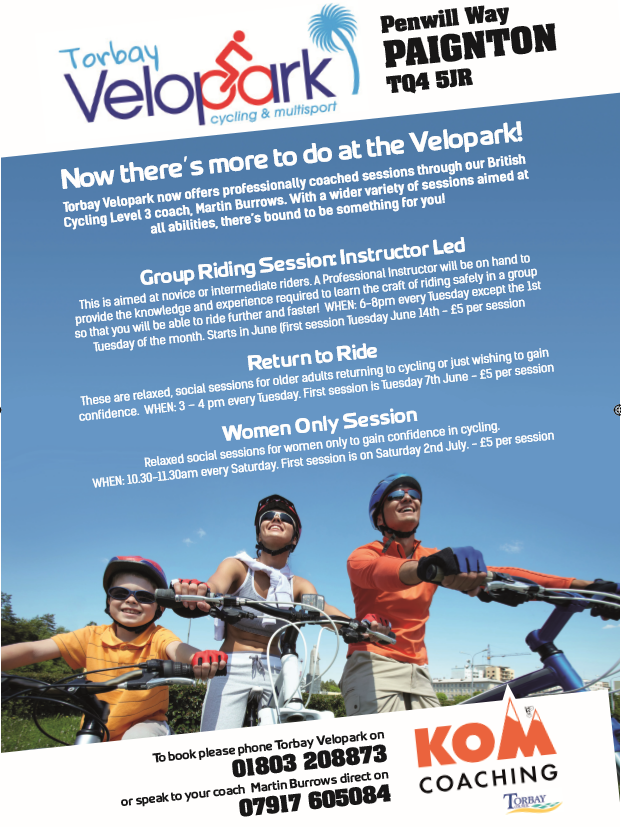
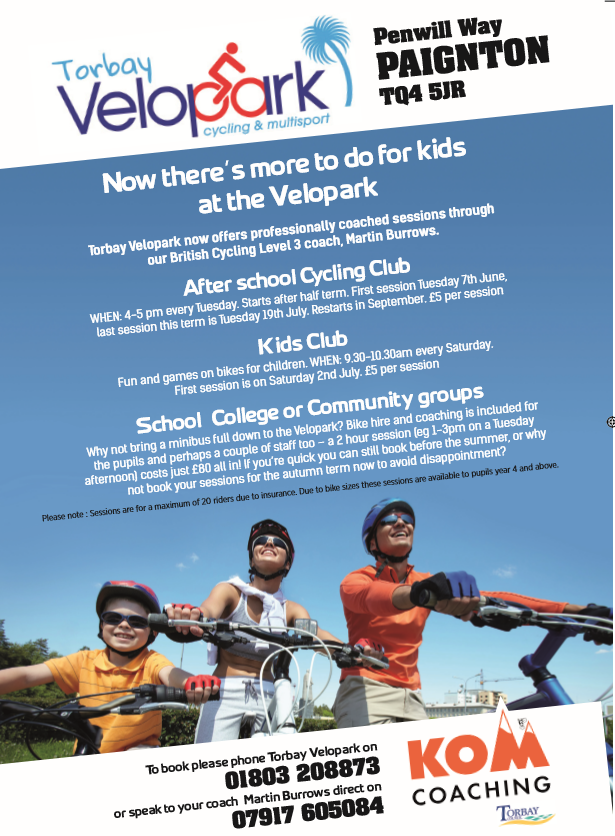
Velopark poster adultVelopark poster child


Tuesday currently sees a ‘return to Ride session at 3-4pm, ‘After School Cycling Club’ at 4-5pm and a ‘Group Riding session’ open to all at 6-8pm.

Saturdays, starting on 2nd July, will offer ‘Kids Club’ from 9.30-10.30am and a ‘Women only’ session form 10.30-11.30am.

All sessions cost just £5

Filed Under: Uncategorised

How to get FITT! A beginners guide

3rd May 2016 By Admin

For those embarking on a training plan for the first time, or perhaps riding without focus and struggling to find fitness, it might be a good idea to go back to basics and get a little understanding of the basic principles behind building fitness. This is where the FITT principle comes in.

The first thing to understand is the effect of training on the body. Let’s start by looking at one single session.

In general terms we train and this ‘stresses’ the body (the muscles, the cardiovascular system etc). For a period after training we are tired, or fatigued. We rest which gives the body chance to recuperate, recover, rebuild itself so it is stronger. The body has adapted and, for a short while at least, it is stronger and can cope with a slightly harder training session. The balance of training and recovery is vital. When to train again and how hard to train are the key. Train too hard with too little rest and you will just get more and more fatigued. It could even lead to overtraining. If you don’t train hard enough or regularly enough, then the body won’t be pushed to adapt and improve (or those temporary improvements will disappear). However, get the balance right and your fitness will improve!


So how do we ensure the right balance to get FITT?

Frequency

How often do you train? A minimum of 3 times a week will bring about significant benefits. Train just once a week and you’re wasting your time! Everything you gain will be lost by the time you ride again. Ideally I’d recommend 5 or 6 times a week for those with the time and training history to support it. Those who are new to training regularly would be best starting with perhaps four days a week (it’s good to stress the body by doing 2 days back to back). In general older athletes tend to need more rest days, so 5 days a week might be ideal. For those in their prime 6 days a week might be best. EVERYONE needs to rest though, even professional athletes, so do include rest days! It’s only when you rest that your body gets stronger.

Intensity

How hard are you training in each session? This can be measured in lots of ways but the three most useful to cyclists are; RPE (rating of perceived exertion) – which is how hard it feels, Heart Rate – which is a way of measuring the stress that the body is under, and Power – which is a measure of the actual output.

RPE is useful and anyone can estimate how hard they are going. With practice and using guides like ‘Borg’s Scale of Perceived Exertion’ it can be a fairly accurate way of estimating the intensity.

Heart Rate is even more useful and a cheap way to measure intensity. It does have limitations though, particularly because it varies for many reasons – the heat, the cold, your level of hydration or dehydration, general stress and many more. It also takes a while to react, so isn’t a particularly good measure for short and/or hard efforts.

Power is the most direct method of measuring intensity as it measures your actual output. It is also rather expensive, so not for everyone.

Whilst Power is definitely recommended for high end racers, Heart Rate and RPE are still really important tools that everyone should use. Even with a power meter they add a lot of useful information. How much stress your body is under (measured by Heart Rate) and how hard it feels are always vitally important.

The good news is that any of these ways of measuring intensity will help you to get fitter. You don’t need a power meter to reach your goals. Even riding on feel, either ‘easy, medium or hard’ can help improve your fitness far more than just riding! Don’t fall into the common trap of always riding hard – everyone benefits from training at different intensities as they train different systems within the body. For example riding ‘easy’ trains the body to burn fat as a fuel more and makes us more efficient, whereas maximum strength gains only come from very high intensities.

If starting to train for the first time spend most of your time at an ‘easy’ intensity and after a while build up to the ’80/20 rule’. 80% of your time spend riding easy, 20% of it harder. Coaches will of course prescribe a much more sophisticated combination of intensities, depending on you and your goals, but this is a good starting point for those new to training.

Time

How long is each training session, and how much time do you spend training in total? Cycling is predominantly an endurance sport, so time is a hugely important! Short, half hour sessions will help, but with a good warm up and cool down a better minimum session length is probably about an hour. Of course when your are in a more advanced stage of training really short intense efforts can have a great effect – but the more intense the sessions the longer a warm up you will need to ensure your body is ready to cope with the intensity and to prevent injury.

To build general fitness, and to get your body to adapt to training either as a beginner, or after a break from training it is best to do longer easier rides first. How long depends on a number of factors, such as your training history (what is your body used to doing) and your goals (are you aiming to ride a couple of hours with friends comfortably, your first Sportive, a 24 hour time trial, a hundred miles a day for a week on a tour of Lands End to John O’ Groats?). Whatever your goal, build up the distance gradually over time. A good rule of thumb is adding about 10% per week. Remember you don’t necessarily need to train as long as your target event either! Another general rule of thumb is to ride up to 80% of your target distance (say if attempting a Sportive) but even that’s not practical for longer events such as a 24 hour TT!

Type

If you want to get better at cycling – ride your bike more! Yes, gym work might make you stronger and cross training (eg running, swimming, circuits) has it’s benefits for your general fitness, but you can’t beat time on the bike if your main goal is cycling related.

What is most important?

First of all, if your goal is a bike ride or race of any kind – ride your bike! The first thing to concentrate on is to train regularly. Otherwise any benefits are lost before the next session. Next build up time on the bike – both the total amount of time spent riding and the length of your longest ride. The biggest single predictor of performance is time spent riding. Ride more, go better! For most people time is also the limiting factor. We are all busy people with jobs, families and busy lives and only have a finite amount of time to spend training. So once you are riding regularly and have built up the time you spend on the bike to the point where you can’t spend more hours in the saddle, that is where intensity becomes more important and can make the difference. Manipulating load and intensity to suit you and your goals is complex issue which I won’t cover this time, but that’s where the knowledge and experience of a professional coach really come in to their own.

If you take one thing from this I can only reiterate the words of the legend Fausto Coppi; “Ride a bike, ride a bike, ride a bike!”

Filed Under: Uncategorised

Dartmoor Classic Sportive Partnership announced!

15th April 2016 By Admin

KOM Coaching are pleased to announce their partnership with the Dartmoor Classic Sportive

As a result, ALL Dartmoor Classic 8 week Training Plans are reduced from the usual price of £30

now just £20        


Filed Under: Uncategorised

Should you adjust your FTP when training indoors and outside?

13th February 2016 By Admin

Doing an FTP test is not the most pleasant of past times! However it really is essential to set your power zones and get the most out of your training.

It’s not unusual to get different results doing indoor and outdoor FTP tests and there are all sorts of reasons why that might be –  inherent differences between the biomechanics of riding on road or in a fixed position on a turbo trainer, the constant fluctuations in road surface and gradient, environmental conditions and motivation to name but a few. This Training Peaks blog goes into some detail about the biomechanical differences in particular.

Is it really worth doing specific FTP tests indoors and out? That’s a difficult one to answer definitively. On balance though, I’d say probably not for the following three reasons;

  1. Your fitness is constantly changing depending on the training you have been doing recently, and the accumulated training over a greater period of time, plus how rested you are. If you did regular FTP tests – say every day, or even several times a day, the chances are your results would be slightly different every time anyway. Then there’s motivation – you need to be really motivated to turn yourself inside out for an accurate FTP test.
  2. Have you tried sticking to exactly 250 Watts (or any other power)? Unless you are on Trainer Road or similar where it’s electronically controlled, it’s impossible to produce an exact amount of power for any length of time. Even on a turbo trainer there is a big fluctuation in the power we produce, and on the road just being in the ballpark can be challenging at times!
  3. Specific physiological adaptations don’t ONLY happen at certain power outputs – or even in certain power zones or levels. Physiological processes are complex and occur on a continuum rather than at specifically defined power outputs. We use zones or levels to indicate a region where certain physical adaptations are most likely strongest, but those adaptations occur throughout a whole range of power outputs and zones or levels to a varying degree.
With all these variables, unless you have noticed a huge difference in results from comparable indoor and outdoor tests, then I don’t think that it’s necessary to test both indoors and outside within the same time period. My conclusion probably won’t shock you – it’s just common sense really; If you know you are doing virtually all your training indoors for a period of time (for instance if you do nearly all your training indoors during the winter) then it makes sense to do your FTP test indoors. When you change to doing the vast majority of your training outside then it might be a good idea to do your next FTP test outside.
Might be? There are a lot of variables to consider when doing an FTP test on the road making it more difficult to get really meaningful results… I’ll perhaps discuss how to make an outdoor FTP test more accurate in another article.


Filed Under: Uncategorised

Mallorca – Cycling in the South

9th February 2016 By Admin

This article written by me, was published on the Tramuntana Cycling website – why not check it out to see what Mallorca has to offer!

Or better still check out the trip to Mallorca we are offering for 2019 in association with Just Events (this trip will be based in the Puerta Pollensa)

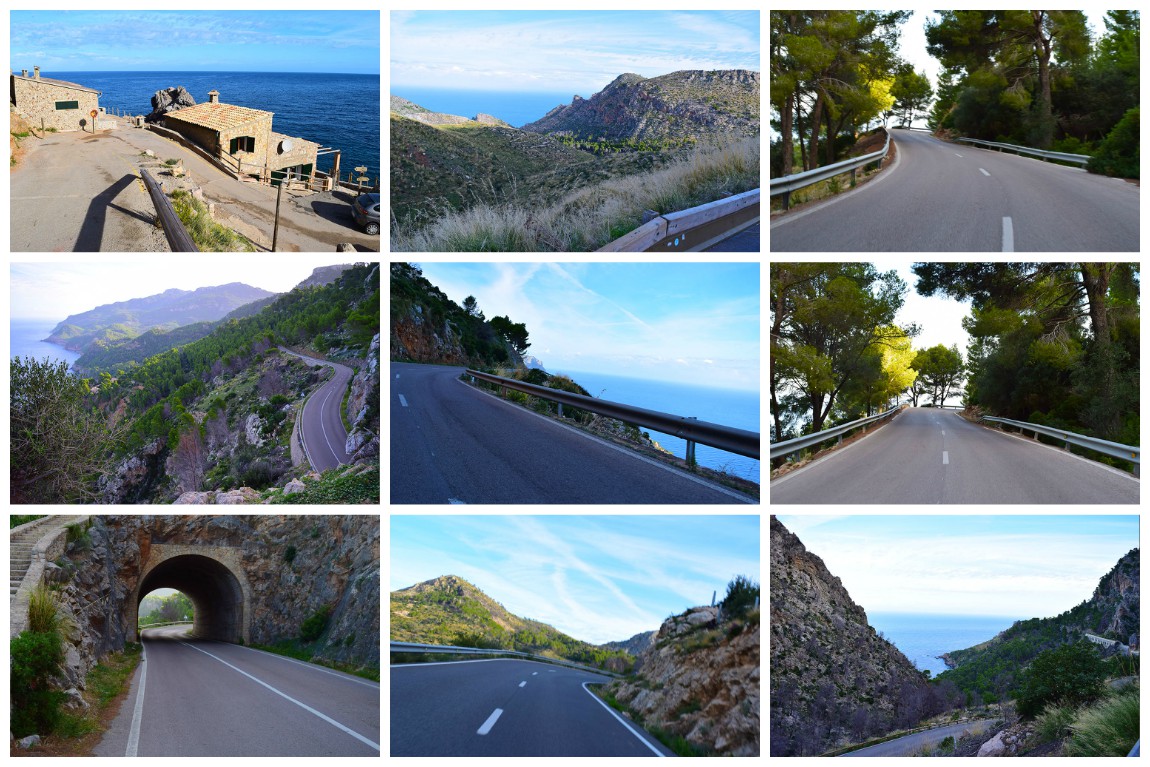
blog-collage_d0520d95895e9d8ca88620871ca10156

Mallorca – Cycling in the South

An alternative to the North?

Every cyclist knows that Mallorca is an ideal base for cycling. Whether you want a serious training camp or to take in the spectacular scenery on a relaxing leisure ride, the miles of quiet roads, varied terrain, friendly motorists who give you plenty of space, the cyclist friendly hotels and facilities, quality bike hire shops, the hordes of like minded cyclists, the sun, the sea, the scenery – and the list goes on – Mallorca has everything a cyclist could wish for.

Traditionally many training camps and holidays from Britain and other parts of Europe have been based in the north of the island, particularly in Port Pollenca, nearby Alcudia or the surrounding area for all the reasons already mentioned but if, like me, you’ve been a few times and fancy a change, what’s it like in the south?

After severcoll-de-soller-7al cycling holidays based in Port Pollenca, I decided to try out the south of the island for a couple of reasons. First of all, being closer to the airport meant a swift transfer and depending on your flight times, this can mean an extra day of cycling. The shorter transfer meant plenty of time to get to the hotel, then hire a bike before lunch, leaving plenty of time for a decent ride on the first day. On a brief four or five day break an extra day really counts!

Secondly, I wanted to try out the climbs and different terrain that the south has to offer. Some of the climbs and the beautiful coastal road from Andratx were just a little out of reach before, unless I wanted to do a real epic ride from the north and back. There are plenty of serious cyclists who ride all the way down to Soller and back from the North, but for most, much of the south west corner of Mallorca is just too much in one day.

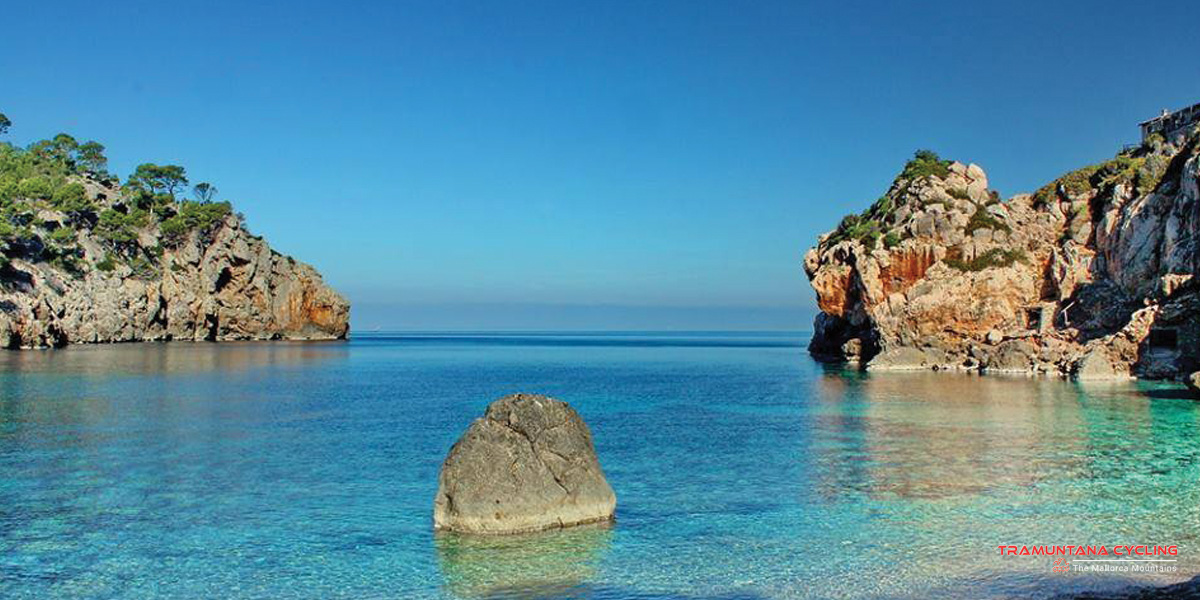
The resorts west of Palma are cala-deia_8b20d8fe823b798b41763ff80ff99ab4ideally placed – close to the airport and near to the hills, beautiful coast and the edge of the Tramuntana mountains. Palmanova and Santa Ponsa both have plentiful accommodation and bike shops hiring nicely spec’d carbon racing machines for the reasonably serious cyclist. 

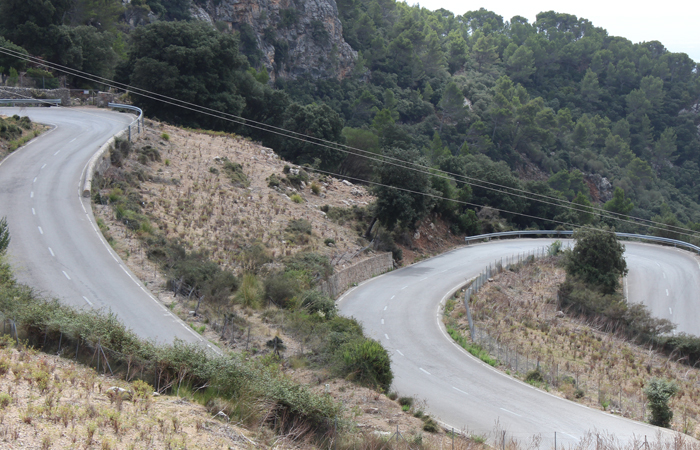
 One of the highlights of the south western corner of Mallorca is the cost road from Andratx. Following the Ma-10, which spans the length of the Tramuntana, the road from Andratx starts with the 5.5km steady 5% climb of the Coll de Sa Gramola, then continues to rise and fall every few kilometres all the way along the spectacular coast past Estellencs, Banyalbufar, and the breathtakingly beautiful Deia to Soller. A return to your base in the south west inevitable takes you over the legendry 7km Coll de Soller with it’s myriad harpin bends – definitely a must-do climb.

As well as the Coll de Soller – from both sides – other major climbs within reach of Palma and the south west resorts are the Coll d’Honor from Bunyola and the Coll de Sa Creu up through the military base just outside Palma both of which offer over 5km of challenging slopes. The interior of the south western peninsular is littered with shorter but delightful hairpinned climbs – indeed the road never seems to be flat for long in this region making for relatively tough going.

The edge of thecoll-de-soller-3 Tramuntana proper is only just within reach – you’d need to be prepared for a really epic ride to make the most of the real mountains. Similarly, if you’re after easier days over flat and rolling terrain it tends to be harder to reach than similar routes are from the northern resorts. For sheer variety of terrain you can’t really beat being based in the traditional cycling hotspots of the north.

Dismiss the south at your peril though. Expect hilly, fairly challenging rides in the south western corner of Mallorca, rather than particularly mountainous or never endingly flat routes and you won’t be disappointed. As elsewhere on the island there is plenty of stunning scenery, you can sample the delights of idyllic towns such as Port D’andratx and Valldemossa and there are dozens of hidden gems out there to discover – whether it’s a breathtaking view at the top of an unnamed climb, or an exquisite cake in a delightful village undiscovered by tourists. If you’re planning a brief trip to Mallorca and particularly if your cycling holidays have been based in northern Mallorca once or twice before, why not go discover the delights of the south for yourself?

Are you interested in guided cycling tours to Mallorca or getting fit enough to enjoy climbing those mountains? Then contact me!

Filed Under: Uncategorised

  • « Previous Page
  • 1
  • …
  • 8
  • 9
  • 10
  • 11
  • 12
  • Next Page »

RSS Unknown Feed

Newsletter

Please subscribe to our newsletter and we'll keep you updated.

Contact Us

  • This field is for validation purposes and should be left unchanged.

© KOM Coaching 2015


Mountain photos with kind permission of Barney Moss @wheresbarney