Logo
  • E-mail
  • Facebook
  • Instagram
  • Twitter

Martin Burrows
07917 605 084
martin@komcoaching.co.uk

Menu   ≡ ╳
  • HOME
  • Personlised COACHING
    • Levels of Coaching
    • Fully Personalised Coaching Compare
  • Fixed Training Plans Intro
    • More Info – Fixed Training Plans
  • Guided Rides & Holidays
  • Gift Vouchers
  • BLOG
  • Why Choose Us?
    • About
      • Testimonials
  • Contact
    • Privacy Policy, T’s &C’s
  • KOM CHALLENGES website

The importance of exercise and a healthy diet

14th June 2018 By Admin

You’ve set a health goal to lose weight, increase your energy

It’s a no-brainer that diet and exercise are both crucial to your well-being and your waistline

Aerobic exercise is the most effective way to burn calories. You should aim to do at least 150 minutes of aerobic activity, such as walking, cycling and swimming, a week.

You can achieve this target by doing 30 minutes, 5 days a week and breaking down your activity sessions in chunks of 10 minutes.

Eating a healthy, balanced diet plays an essential role in maintaining a healthy weight, which is an important part of overall good health.

Being overweight or obese can lead to health conditions such as type 2 diabetes, certain cancers, heart disease and stroke. Being underweight could also affect your health.

Your food choices each day affect your health — how you feel today, tomorrow, and in the future.

Good nutrition is an important part of leading a healthy lifestyle. Combined with physical activity, your diet can help you to reach and maintain a healthy weight, reduce your risk of chronic diseases (like heart disease and cancer), and promote your overall health.
Filed Under: Uncategorised

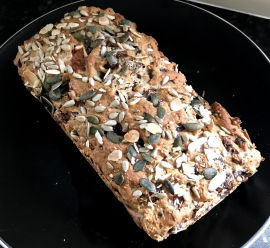
Wholemeal, fat-free, sugar-free, sultana tea loaf

13th June 2018 By Admin


Ingredients

  • Mug of sultanas
  • Mug of freshly brewed tea
  • Mug of bran flakes (optional)
  • Mug of self raising wholemeal flour x2
  • Teaspoon baking powder
  • Seed topping is optional
  • Loaf tin lined with baking parchment
  • Oven Temperature –  GAS MARK 4 – ELECTRIC 200 – FAN 180

Preparation

  1. Soak sultanas in the freshly brewed tea, and leave to soak for a good few hours
  2. Add bran flakes and stir, then add baking powder and flour and mix well.
  3. Tip into loaf tin and bake in oven for approx 40-50 minutes.

Tips

If, when adding flour, mixture is too dry you can always add extra fluid, whether it be some more tea if you have any left over or milk, but note if adding milk the cake then is not fat-free.

Recipe courtesy of @challengeannika

Filed Under: Uncategorised

Ben’s story

15th May 2018 By Admin

2017 was a significant year for me – I turned 40. I had some goals that we were important to me to achieve before I hit 40 and becoming a Veteran: getting GOLD on the Dartmoor classic, doing well on the MTB Marathon series, and running my first marathon. Along the way there were other sportives (Ride London) and events (Big Bike Bash) which I wanted to enjoy.


I’ve had similar goals in previous years but often failed to reach them. I decided I needed a coach to help me plan and keep me on track. While I was doing a course I met Martin, following a chat about my goals I felt Martin would be ideal and we started working together in February. Having already set out my goals our first meeting was able to focus in how those goals could be achieved and breaking the season down into chunks. Martin’s approach was to make best use of my time in busy weeks, rather than requiring changes in my work and family commitments.


I was using Martin’s gold plan so I was getting daily feedback. For me the regular communication (mostly through Training Peaks) was key, I had stop on reflect on each training session and think about how it went. Martin clearly made use of the data gathered via my Garmin device to see if I committed to the session and tailor future sessions. Martin’s encouragement and advice made it easier to prioritise the next session, focusing effort where it mattered.


I achieved my goal on the Dartmoor classic and the ride London I exceeded my own expectations. By the time the MTB marathon series finished in the Peak District I was super pleased with my performance, but I was tired and needed a change. There was still one goal for the season to be achieved a marathon. I has done some running early in the season, up to 10km, but that had been dropped to focus on the bike.


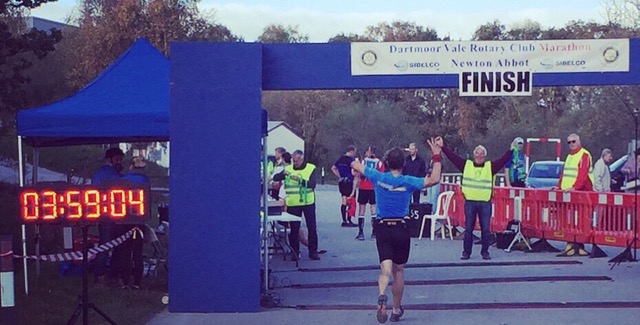
The Marathon I selected was the Sibelco Dartmoor Vale Marathon on the 29th Oct. A local race on a route I thought was flat. I also decided that 4 hours was a respectable target. Training started on the 5th September – 8 weeks to go. I had the fitness for a four hour endurance event, but not the running experience. Working again around my commitments Martin set out a plan which gradually ramped things up. I knew that missing a session was not an option if I wanted to hit this goal. I now had greater confidence and I knew what I had to do in Martin and was happy to work on his silver plan, so feedback was weekly. If this were a film there would now follow a montage of running in all weathers and different trails to some cool music. There was still some biking, including a weekend trip to Wales for some Downhilling; surely a big risk of injury, but considered in Martin’s plan. The longest run before the event was 30km. So the event its self was a big challenge. The first half was fast, maybe too fast and the second half a real mental challenge, but great support from the other runners. As I came in to the finish I was told by others this was one of the toughest Marathon courses due to the hills – so much for being flat. I just beat 4 hours!

8 weeks training for a first marathon is not normal, Martin and I did discuss the risks of doing this. Through out the whole time Martin was supportive and provided the focus I need to achieved my goal.


Please note: Training for a marathon, from occasional runner to marathon runner in just 8 weeks is NOT recommended. However this was the timescale that Ben chose after we discussed the fact that training on such a tight timescale would really increase the likelihood of overtraining or injury. We would usually recommend approximately 16 weeks of more progressive training for better results, depending on the athlete. 

See Ben’s and other testimonials

Filed Under: Uncategorised

Chris Jackson, Ultra Endurance athlete article – ‘Coaching – it helps!’

15th May 2018 By Admin

Cycle coaching – it helps!


Chris Jackson is relatively new to cycling, but in 2016 he set himself a huge goal – to enter the world of Ultra Endurance cycling and specifically the Trans Atlantic Way Race (#TAWR). In a just a few short weeks he’ll tackle his second TAWR. Chris has set up his own website and regularly blogs  – here are a few extracts from ‘Cycle coaching – it helps!’


Just because you or I are “lowly” amateurs of varying ages, ambition, experience and levels of ability doesn’t mean we don’t deserve or won’t benefit from coaching. If you’re planning to complete an endurance race such as the TAWR then make no mistake you are, or swiftly need, to become an “athlete”.


“Having a coach setting my training plans, analysing my performance numbers and offering feedback has really helped with my focus, commitment, sense of direction and confidence. I always know he’s watching. If I skip a training ride, I’ll have to explain and it’s not often that I do.”


“Training Peaks introduced me to Martin Burrows from KOM Coaching. Martin has 20 or so years of coaching experience, is highly qualified and a pleasure to work with. He recognises that coaching is an art and that every athlete is unique with differing strengths, weaknesses and goals. He focuses flexibly on what you need at any given time rather than any hard and fast preconceived agenda of his own.”

Read the whole article here, and check out Chris’s website; whizzyflywheel.co.uk

See Chris’s and other testimonials

Filed Under: Uncategorised

Indoor Cycling with Stages Power – training harder?

10th November 2017 By Admin

Each Monday Bay Cycles hit the Venning Ride studios for a high octane indoor cycling session. In this series of articles I’ll be looking at the wealth of data to be gleaned from the Stages Power bikes to help you understand how to get the most out of this great opportunity to train with power.

Comparing Workouts

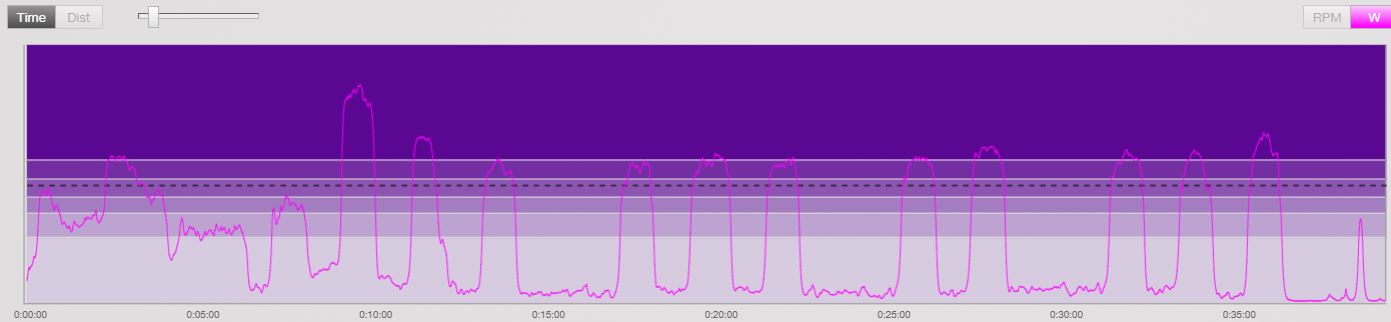
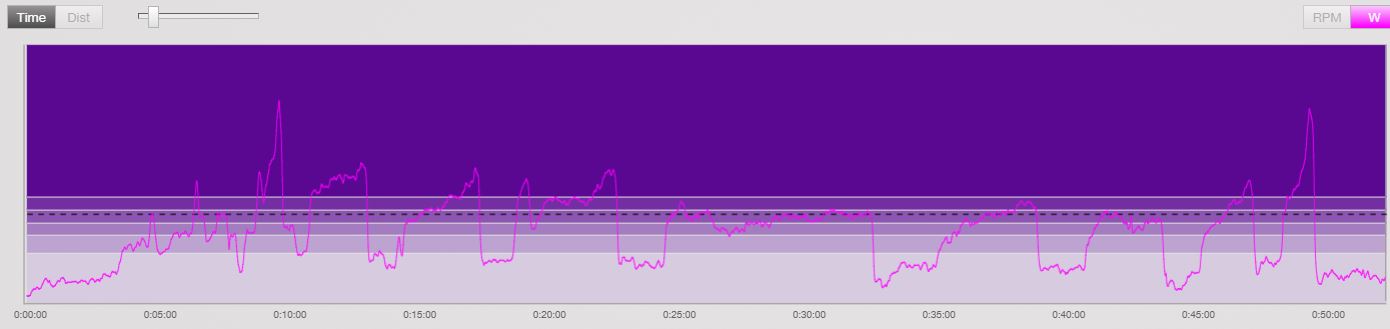
Here I am going to compare Lisa’s efforts this week with her ride the week before, in an effort to find out if she trained harder!  You might want to look at last weeks article to understand some of the things I will talk about like ‘threshold’ etc. Lets start by putting graphs of her power with zones in the background from last week and this week side by side.

Week 1 Power trace

Week 2 Power trace

Number of efforts

The first thing you might notice is how different the two sessions look. In week 1 there were lots more spikes. There were 12 really big efforts above threshold (the dotted black line) in week 1. In week 2 there were only about 6, with a couple more times where the effort just sneaked over threshold.

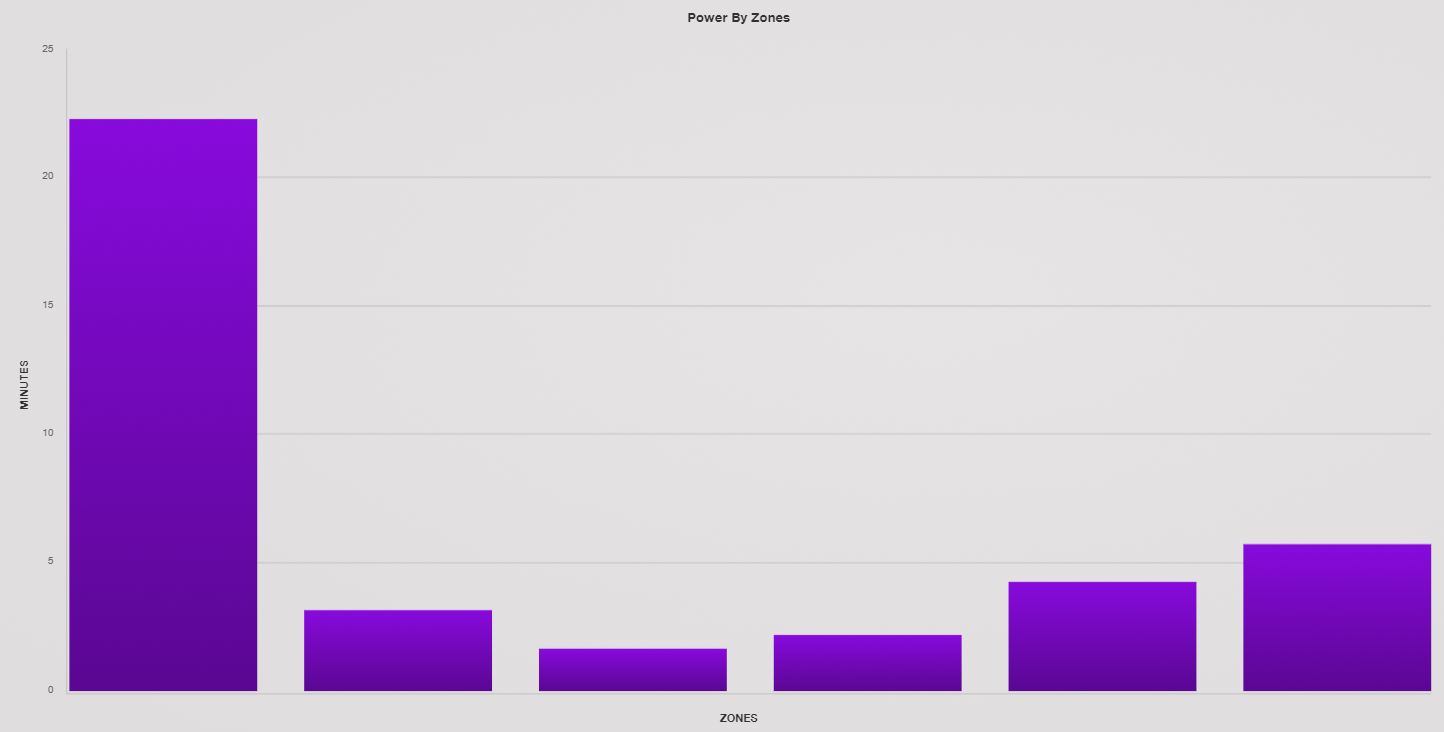
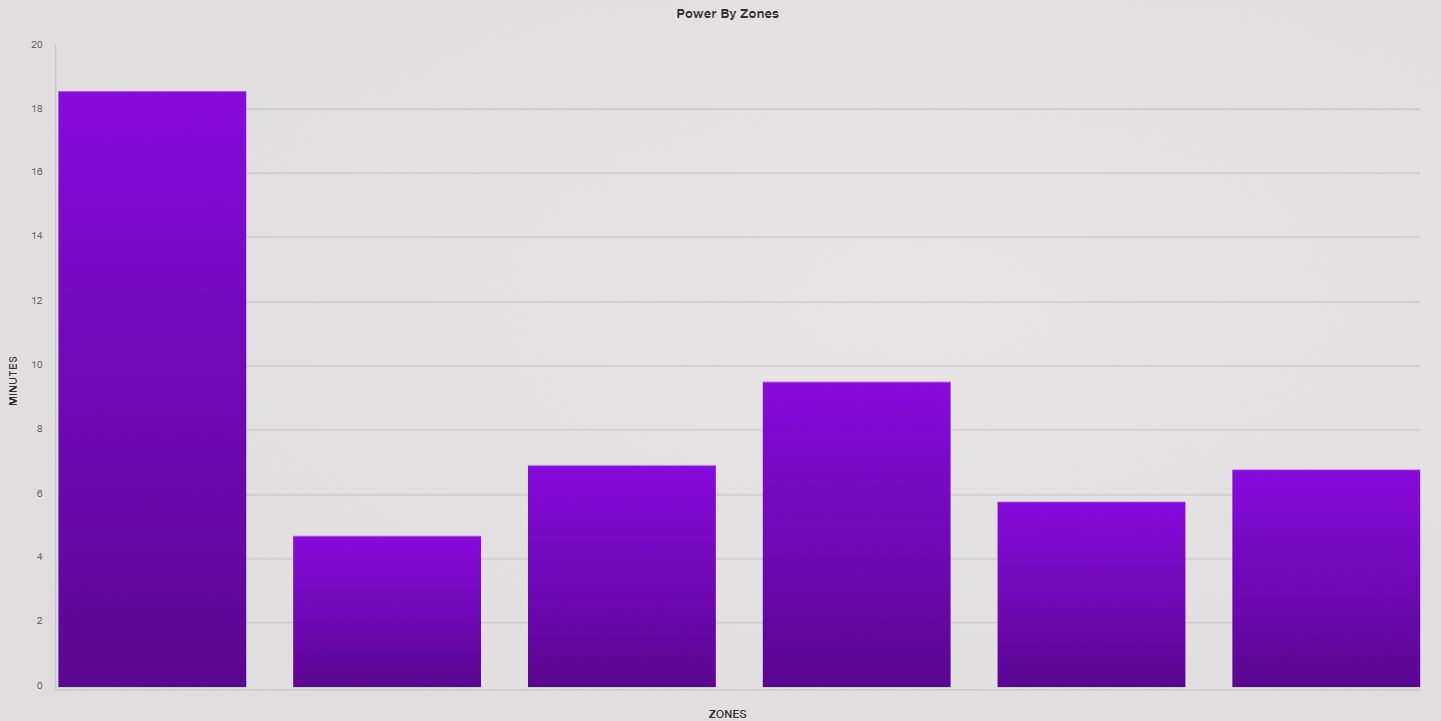
So does that mean that in week 1 Lisa tried harder? Not necessarily – it means in week 1 Lisa made more efforts above threshold but we also need to consider how long the efforts lasted. So lets look at another pair of graphs showing ‘Time in Zones’;

Week 1 Time in Zones

Week 2 Time in Zones

Time in Zones

Again you’ll notice the graphs are quite different, BUT in terms of those efforts above threshold, time spent in zones 5 and 6 was remarkably similar. In both weeks Lisa spent 11% of her time in zone 5 and 13% against 15% in zone 6. The session was a little longer in week 2 so in actual fact Lisa spent a little more time above threshold in the second week – so in this particular way, Lisa trained a tiny bit harder in week 2.

Sustainable Power

Where these graphs really differ is in the time spent in Zone 4. This zone is also known as ‘Threshold’ as it is the zone just below and just above threshold. The nature of this session (week 2) was to work much more around threshold (zone 4). Training in this zone, unsurprisingly, helps to improve your threshold (FTP and/or Lactate Threshold) which is basically your sustainable power. You can clearly see that more time was spent at or very close to threshold in week 2 on both of these pairs of graphs. This is a tough zone to work in and fantastic for boosting sustainable power, so again, week 2 was a harder session in this way too.

Overall Intensity

Last week I introduced Intensity Factor (IF) which measures the overall intensity of a workout relative to your threshold (FTP). In week 1 Lisa’s IF was 0.90 which means she averaged 90% of her threshold for the whole workout. A hard session! We’ve seen how this weeks session has been harder at threshold and above, so I’d expect to see the IF even higher this week. In fact it was a huge 0.98, ie 98% of her threshold on average! This is an exceptionally high effort level, so kudos to Lisa for giving it everything! What this also suggests is that Lisa’s threshold has risen since we calculated it – a sign of her fitness improving.

Training ‘Stress’

I’m going to finish this week by adding in one other way to compare our efforts from one workout to another – TSS or Training Stress Score. Every time we train we ‘stress’ the body. The body reacts to this stress by rebuilding and getting just a little stronger for next time. This is how training works to make us fitter, stronger and faster – Train (stress the body), Recover (the body gets stronger), Train (ride again and stress the body more), Recover (get a little stronger) and so on. TSS is a way to measure this stress. It is useful so that we can build up our fitness over time, and also because too much training stress will only make us excessively fatigued to a point where our fitness will decline.

Training Stress Score is a combination of both the amount of time you train and the intensity at which you train. So training for longer and/or harder will give you a higher TSS. So, for one final confirmation that Lisa trained harder in week 2 we can look at her TSS. In week 1, TSS was 53. It was 84 in week 2! This was down to the session being both a little longer and more intense.

Chapeau to Lisa!

Training Effects

So we’ve looked at a few ways to compare different workouts. Just a word of caution though. The various measures and numbers are really useful and tell us lots about the nature of a workout and how hard a rider has tried. But bigger numbers are not always better. It all depends on your long term aims and goals, and what you are trying to achieve in that particular session. One session is not necessarily better or worse than any other. Rather, each session will have different training effects.

So you can relax a little Lisa, you don’t have to ‘beat’ the numbers you achieved this week. I’m sure Paul at Venning Ride has got another great session lined up for you next week – but that might have a very different goal and improve your fitness in a different way to either of the sessions you have done so far.

Just ride hard and enjoy the Sufferfest!

Filed Under: Uncategorised

  • « Previous Page
  • 1
  • …
  • 4
  • 5
  • 6
  • 7
  • 8
  • …
  • 12
  • Next Page »

RSS Unknown Feed

Newsletter

Please subscribe to our newsletter and we'll keep you updated.

Contact Us

  • This field is for validation purposes and should be left unchanged.

© KOM Coaching 2015


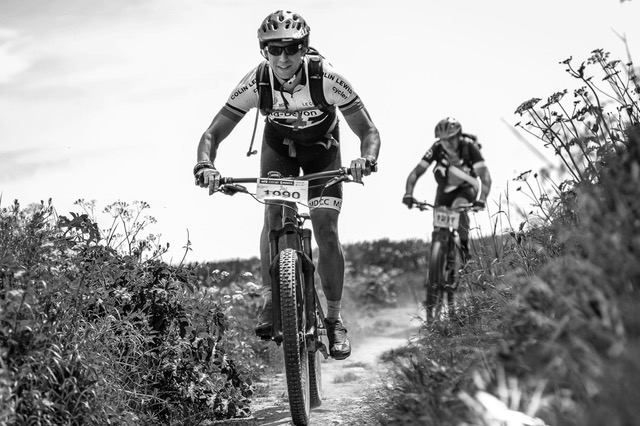
Mountain photos with kind permission of Barney Moss @wheresbarney